



The Truth about Truth Drugs
What is a "truth drug" and what drugs are used?
A truth drug is a drug used for the purposes of obtaining accurate information from an unwilling subject, most often by a police, intelligence, or military organization on a prisoner.
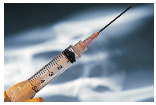
Drugs used for the purpose of obtaining the truth from people have included alcohol, scopolamine, and sodium thiopental (more commonly known as sodiumpentothal)—all sedatives that interfere particularly with judgement and higher cognitive function. Whilst alcohol is used by this purpose by many individuals in a more innocent sense, it is apparently used by professionals in the areas as well. A book by a former Soviet KGB officer based in Washington, Washington Station, details the use of near-pure alcohol to verify that a Soviet agent was not compromised by US counter-intelligence services.
The CIA's MK-ULTRA Project
The United States Central Intelligence Agency conducted a series of experiments in the 1950s and 1960s, collectively known as the MK-ULTRA Project, designed to find a perfect truth serum for use against Soviet agents. Initial efforts focused on LSD and doses of barbiturates and then amphetamines given in rapid succession, but the project was ultimately abandoned after mixed results.
Whilst fictional accounts of intelligence interrogation gives these drugs near magical abilities, information obtained by publicly-disclosed truth drugs has been shown to be highly unreliable, with subjects apparently freely mixing fact and fantasy. Much of the claimed effect relies on the belief of the subject that they cannot tell a lie while under the influence of the drug.
Use of truth drugs today
As of 1993 in Canada these were still used to help diagnose schizophrenic subjects, especially paranoia where the difficulty was to get the subject to talk at all. Subjects experienced with other hallucinogenic drugs reported similarity of effects of sodium amytal to that of LSD or psilocybin, but for a 20 minute period.
Interest in their use outside intelligence services has since declined to negligible levels—though their use has been reexamined after the September 11, 2001 Terrorist Attacks. It is possible, but thought unlikely by experts in anaesthetics (the drugs most closely resembling truth drugs in common use), that intelligence services do have more effective such drugs at their disposal which they have not disclosed.