



An Introduction to Classical and Operant Conditioning in Psychology
Conditioning in behavioral psychology is a theory that the reaction ("response") to an object or event ("stimulus") by a person or animal can be modified by 'learning', or conditioning. The most well-known form of this is Classical Conditioning (see below), and Skinner built on it to produce Operant Conditioning.
Conditioning
Pavlov's Discovery of Conditioning
This mode of learning was demonstrated by the experiments of Ivan Pavlov, who decided to research conditioning after discovering during separate gastric tests that his dog subjects began to salivate not only when meat powder was presented to them, but more significantly, when the person feeding them came into proximity with them. The dogs had been inadvertently trained through classical conditioning to associate the person feeding them with the food itself, and reacted in a similar way (salivation) to the feeders. This is known as a stimulus-response (SR), when salivation becomes a responsive action to the stimulus of the person feeding the dogs:
At the start of the experiments:
- The Unconditioned/Neutral Stimulus (US/NS) is the person arriving to feed the dogs before the salivation as a result of their presence had began.
- The Unconditioned Response (UR) was for the dogs not to salivate.
By the end of the experiments, when the unconditioned stimulus and responses had been conditioned:
- The Conditioned Stimulus (CS) becomes the person arriving to feed the dogs, which stimulates the Conditioned Response:
- The Conditioned Response (CR) becomes salivation (normally a reflex action to aid digestion when feeding is going to begin) at the sight of the person.
On discovering this associative learning on the part of the dogs, Pavlov decided to carry out further research specific to conditioning...
Classical Conditioning
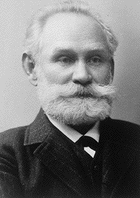
Russian physiologist Ivan Pavlov (1849-1936) became eponymous with his dog conditioning experiments.
The most famous experiment by the physiologist related to conditioning followed this research. Commonly referred to as "Pavlov's Dogs", the experiment aimed to condition the dogs to associate the opening of a doorwith feeding time. By selecting a bell as the Unconditioned Stimulus instead of the person arriving to feed the dogs, as in his previous tests, Pavlov was providing a stimulus to which feeding was unrelated.
At feeding time, the door was opened and food was then provided. Initially, salivation was not secreted with the opening of the door, but over time, the stimulus became conditioned, and when the door was opened but food was not provided, salivation still occured, suggesting that the door opening had become a Conditioned Stimulus.
Instrumental Learning
An extension of Classical Conditioning was devised by Edward Thorndike (1874-1949), who placed cats in a puzzle box. The incentive of a fish as food was placed outside of the box, giving the cats a reason to try to escape from the box. Initially, they had trouble escaping, and only gained freedom by knocking the latch of the box. Over time, they learnt that the undoing of the latch would enable their escape, and so the time spend being trapped in the puzzle box decreased as their knowledge of how to leave it increased.
Thorndike termed this conditioning the "Law of Effect" in 1911: a positive outcome to a situation resulted in the stamping in of a particular behavior (in the case of the puzzle box, the opening of the latch was stamped in). Conversely, if an outcome is undesirable - had the cats been punished as a result of leaving the box - the action leaving to it would be stamped out - become less frequent.
Operant Conditioning and Reinforcement
In 1938, B.F. Skinner carried out an experiment with caged rats in an "operant conditioning chamber" - Skinner's Box - who learnt through Operant Conditioning that if they pressed on a lever, food would be released for them. Under Operant Conditioning, reinforcement plays a key role:
| Reinforcement Type: | Description: | Tendency to Behave in a Particular Manner: |
|---|---|---|
| Positive Reinforcement | A stimulus is introduced which incentivises a particular behavior. e.g. the reward of a pellet of food in Skinner's Box. | Increases |
| Negative Reinforcement | A desirable incentive is introduced to not behave in a particular way. | Increases |
| Positive Punishment | An undesirable punishment (e.g. electric shock) is introduced when the subject behaves in a particular way, discouraging such behavior. | Decreases |
| Negative Punishment | Removing the desirable stimulus (e.g. food) to prevent a particular behavior. | Decreases |
The key difference between operant conditioning and classical conditioning is that the former creates association based on the result of a subject's behavior and the outcome that it generates as a secondary effect, whereas classical conditioning more primitively concentrates on the behavior itself.
Examples of Conditioning
A dog receiving positive attention after fetching a stick back to its owner, learns to associate bringing the object back with favorable attention - positive reinforcement.
A rat in a cage with an electrified floor learns that by pressing a lever, the electrical shock will stop - negative reinforcement.
A cat being shouted at for scratching furniture is discouraged to repeat this - positive punishment.
A child not being allowed to watch television after misbehaving associates bad behavior with an absence of rewards - negative punishment.
Criticisms
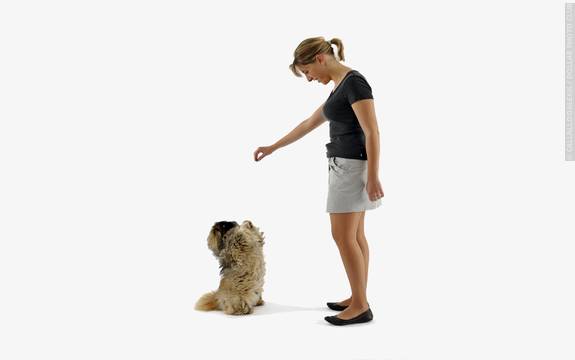
- Conditioning has numerous practical applications in everyday training and education. Animal training routinely uses conditioning, with food treats as a form of positive reinforcement for good behavior.
- Generalisation of Association: A danger, particularly of the positive punishments described above, is that a subject may begin to associate an undesirable reinforcement with stimuli beyond those originally intended. This was demonstrated in Skinner's Little Albert experiment, in which Albert heard a loud noise on the sight of a white rat. However, in addition to an aversion to white rats, Albert gained a phobia of anything that resembled it - including, for example, white beards.
See Also:
- What Issues Can Affect Classical Conditioning?
- Criticisms of Classical Conditioning (in Stimulus-Response Theory main article)